What Is Real in ‘Prahaar – The Ujjwal Nikam Story’: Court Records, Public Statements, and What’s Dramatized
‘Prahaar – The Ujjwal Nikam Story’ claims inspiration from India’s most-watched terrorism trial, but its ties to public domain court documents are not confirmed. Here’s what’s actually on record, where you can read original judgments, and what remains artistic liberty.
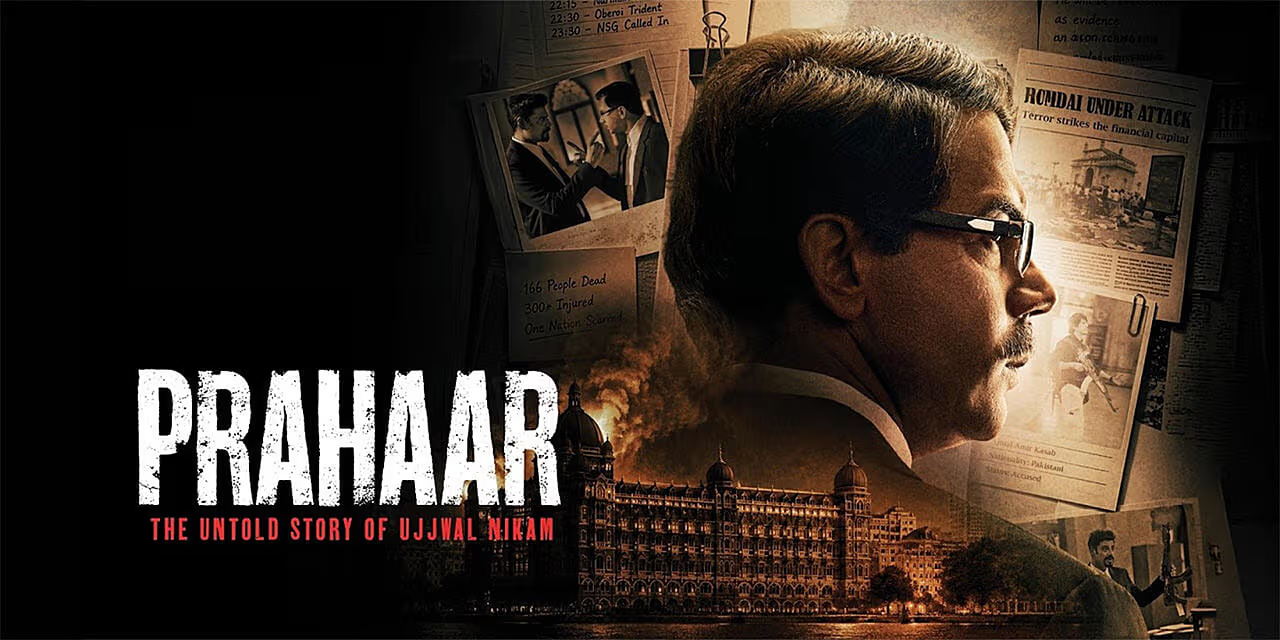
Prahaar – The Ujjwal Nikam Story draws from the headline cases prosecuted by Ujjwal Nikam, notably the 26/11 Mumbai attacks trial against Ajmal Kasab. While the film is touted as inspired by Nikam’s legal career, there is no public evidence that the script directly adapts actual court documents or public domain transcripts. International readers can access key judgments and some official statements, but the film’s dramatic scenes appear to be narrative recreations, not verbatim legal transcripts.
How much of ‘Prahaar’ is based on official court records?
There is no official confirmation that the filmmakers behind Prahaar used, cited, or adapted public domain court records or legal transcripts for the movie’s content. Promotional materials, including the IMDb listing and press teasers, describe the film as “inspired by” Ujjwal Nikam’s life and prosecutions. They do not reference reliance on legal documents for screenplay or dialogue. This leaves open the likelihood of creative license—combining some real-life details with fictionalized storytelling for dramatic impact.
For the 26/11 trial specifically, the detailed sequence of Nikam’s arguments, witness statements, and verdict grounds are available in high court and Supreme Court judgments published in the public domain. However, there is no indication that Prahaar quotes or stages these proceedings verbatim, nor that viewers will see courtroom scenes precisely as they unfolded. Instead, the film appears to use the overall story arc of the prosecution to build a legal thriller, borrowing major plot points but not literal trial records.
Where do the film’s stories and characters draw from?
The film’s main narrative draws on Nikam’s public career as Maharashtra’s most prominent special public prosecutor. He led high-profile cases including the prosecution against Ajmal Kasab, one of the attackers during the November 2008 Mumbai attacks. The teaser and initial press coverage focus on the Kasab trial, which is one of the best-documented legal proceedings in contemporary Indian criminal history. Still, there is no transcript-by-transcript adaptation; instead, Prahaar blends public record with dramatization for cinematic effect.
What official transcripts and records are actually available?
International readers seeking primary source material will find a range of court documents publicly available. These include:
- Supreme Court and Bombay High Court judgments: These compile the prosecution’s arguments, defense statements, witness summaries, and legal reasoning—often quoting or summarizing important exchanges but not offering full trial transcripts.
- Indian Kanoon: An open-access legal research website indexing judgments and court orders. The full judgment in Mohammed Ajmal Mohammad vs The State Of Maharashtra (the Kasab case) is searchable here.
- National Investigation Agency: The NIA’s website hosts a PDF of the Mumbai High Court judgment on the Kasab trial. It includes factual findings, a timeline of events, and reflections on the arguments—readable in full here.
It’s important to note: Indian courts do not typically publish full verbatim transcripts of every courtroom exchange. Instead, the judges’ written orders and verdicts summarize or select key lines and arguments from lawyers and witnesses. This means that while you can read what Nikam said and did as recorded by courts, not every line in the courtroom is preserved word-for-word.
Where can readers find Ujjwal Nikam’s original statements?
Statements by Ujjwal Nikam are available in several forms:
- Within judgments: Salient submissions and specific points as argued by Nikam appear in the judicial record, especially in important cases. These are collated in the aforementioned Indian Kanoon and NIA records.
- Media interviews: Nikam has frequently spoken to Indian national media, sharing insights about trials and prosecution strategies. His most famous off-court remark—that Ajmal Kasab “never asked for mutton biryani”—was admitted by Nikam as a fabrication meant to sway public opinion. This admission featured in a 2015 Indian Express interview, now part of the public record.
If you are looking for Nikam’s own explanations or context behind key cases, press interviews and reported statements are the most direct sources, outside of the selective courtroom record. These are not always complete transcripts but do represent the prosecutor’s own words and intentions.
What about the famous “biryani” story?
One of the most retold stories about the Kasab trial was the claim (amplified by much of the press and political discourse) that the attacker demanded special meals—specifically, mutton biryani—while in custody. In 2015, Ujjwal Nikam himself admitted to The Indian Express that he had invented this story as a tactical move to influence public and political perception. This is one concrete example of where a narrative, widely believed at the time, turned out to be a calculated fabrication for extra-judicial purposes. The actual trial record clarifies that such an exchange did not occur in court or custody.
What does this mean for legal authenticity in 'Prahaar'?
Prahaar does not identify itself as a documentary or claim strict factual retelling. Instead, it creates a story based on real events, with dramatized scenes that may include composite characters, invented dialogue, and tightened narratives. For viewers focused on legal realism, this approach means caution is needed if trying to draw direct connections from what is seen on screen to the underlying public record.
The film’s goal may be to communicate the stakes and emotional drama of rare, high-stakes Indian terror prosecutions rather than serving as a legal document. The difference between the two—record and recreation—matters for anyone using Prahaar as an account of history versus as a work of cinema inspired by it.
How can international readers access the trial record?
Non-Indian viewers and diaspora audiences can freely access the landmark court judgments through the following platforms:
- Indian Kanoon: Searchable by party, case name, or topic. For the main Kasab verdict, use the specific link.
- National Investigation Agency: Access full-text PDFs of important terrorism-related judgments, including the prosecution’s summary, trial chronology, and court findings for the 26/11 case.
These resources are open to international visitors, with no registration required as of August 2026. Full verbatim transcripts of courtroom arguments are seldom available, but judgment summaries contain large excerpts and paraphrases of key exchanges featuring Ujjwal Nikam and other principal actors in court.
For in-depth stories on how Hindi films draw from real cases—and how to check what’s fact and what’s fiction—see our Explainers and Features coverage.
Spotted an error? We publish corrections openly — email editor@thebollywoodwave.com and read our corrections policy.